
Risk registers
Risk Register Template: Fields, Ownership, Scoring and Escalation
Build a useful risk register with clear statements, accountable ownership, consistent scoring and actionable escalation.
A risk register should help people decide, not simply prove that risks were recorded. The strongest registers make ownership, assessment, treatment and review easy to understand.
The right fields depend on the operating model, but a practical core works across enterprise, operational, IT and cyber risk.
Write a complete risk statement
Describe the uncertain event or condition, its cause and its consequence. Avoid one-word labels such as cyber, supplier or staffing.
A useful structure is: Because of a cause, an uncertain event may occur, leading to a consequence for an objective, service or stakeholder.
- Cause or source
- Uncertain event
- Consequence
- Affected objective, service or process
Assign accountable ownership
Name one accountable risk owner who has authority to understand and influence the response. Contributors may support updates, but shared accountability often becomes no accountability.
Record the organizational area and review date. Use a visible exception when ownership is unresolved.
Use consistent categories and status values
Categories support aggregation only when people apply them consistently. Publish definitions and examples, and limit the list to values that support decisions.
Status should describe the working state, such as draft, active, under review or archived. Do not mix workflow status with risk severity.
Separate inherent and residual risk
Inherent risk reflects exposure before considering controls. Residual risk reflects exposure after considering the relevant controls and their current effectiveness.
Record likelihood and impact separately, then calculate a score or rating using an agreed matrix. A number alone is not the decision. Document the scale and what each band means.
Connect controls and treatment
List the important controls that change likelihood or impact. Record ownership and how effectiveness is assessed.
If residual exposure is outside appetite or otherwise unacceptable, document the response: avoid, reduce, transfer or accept. Connect action owners and dates to that decision.
Define review and escalation
Set a review frequency appropriate to volatility and significance. Event-driven review may be needed after incidents, major changes, control failures or new obligations.
Escalation rules should identify thresholds, overdue treatment, appetite exceptions and material changes. State who receives the escalation and what decision is expected.
Download the template
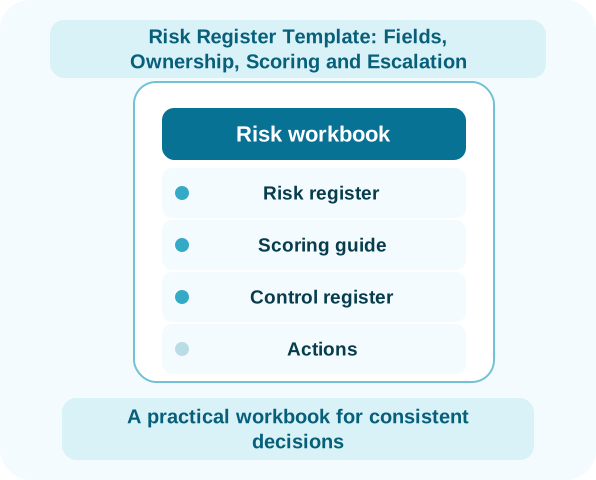
The free Parapet Excel risk register template includes scoring guidance, validation values, a control register and an action tracker.
When several teams need controlled access and consolidated reporting, review Parapet risk register software as the next step beyond spreadsheets.
Test the register with one decision
Choose a risk due for review and ask whether the register shows the decision needed, accountable owner, current exposure, controls that materially influence it and unfinished treatment. Remove any field that does not help that decision or a defined reporting need.