
Enterprise risk
How to Create a Consistent Enterprise Risk Taxonomy
Create clear risk categories and definitions that support consistent use across business units and risk domains.
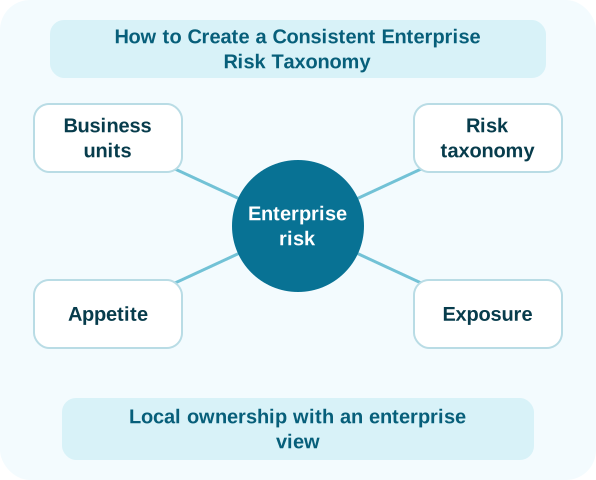
A risk taxonomy provides a common way to classify exposure across an organization. It supports aggregation only when people understand and use it consistently.
The goal is not to create the most detailed hierarchy. It is to create a stable language that improves ownership, comparison and decisions.
A small example
A compact enterprise layer can coexist with more detailed local classifications. The definition and boundary matter more than the number of categories.
| Enterprise category | Include | Do not use it as a shortcut for |
|---|---|---|
| Strategic | Uncertainty affecting strategic choices or organization-wide objectives | Every high-rated risk |
| Operational | Failure in people, process, service delivery or external dependency | Any issue owned by an operations team |
| Technology and cyber | Technology availability, integrity, confidentiality or change exposure | Every business impact caused by technology |
| Legal and compliance | Exposure arising from an obligation or legal position | All controls and audit findings |
Start with decision needs
Identify how the taxonomy will be used in appetite, reporting, ownership and resource allocation. Categories that do not support a decision may not belong in the enterprise layer.
Review common questions from executives, risk committees and business units before choosing the hierarchy.
Separate sources, events and consequences
Organizations often mix causes, risk events and impacts in one category list. This makes classification inconsistent.
Define what the primary taxonomy represents. Record causes and consequences in separate fields or linked structures when they need independent analysis.
Keep the enterprise layer manageable
Use a limited number of top-level categories with clear definitions and examples. Add subcategories only where they improve routing or analysis.
Business units may use local tags or subcategories while mapping to the enterprise categories required for consolidation.
Define boundaries and overlaps
Risk can span technology, operations, compliance and third parties. Publish guidance for common overlaps and define when multiple categories are appropriate.
Do not force complex risks into an arbitrary single label if the platform can support primary and secondary classification.
Assign governance
Name an owner for the taxonomy and define how changes are requested, assessed, approved and communicated.
Version definitions and review the impact on trend reporting before changing categories.
Test with disagreement, not easy examples
Give the same cross-domain risks to people from several business units and compare their choices. A supplier technology failure that disrupts a service is a better test than an obvious single-domain example.
When experienced users disagree, record why. The answer may be a clearer boundary, a primary and secondary category, or a deliberate decision to classify by consequence rather than source.
Monitor data quality
Track unclassified risks, overused categories, frequent reclassification and heavy use of other. These patterns reveal where the taxonomy or guidance needs attention.
Parapet can combine shared catalogs with team context. Review enterprise risk management in Parapet and the register consolidation guide.
Keep a taxonomy decision log
For every category boundary, record one included example, one excluded example, the owner of the definition and the reporting decision it supports. This short record is more useful than a long label description when two teams disagree later.