
Software evaluation
GRC Software Pricing: Users, Modules and Usage-Based Models
Compare per-user, per-module, platform and usage-based pricing before requesting a complete GRC or IRM quote.
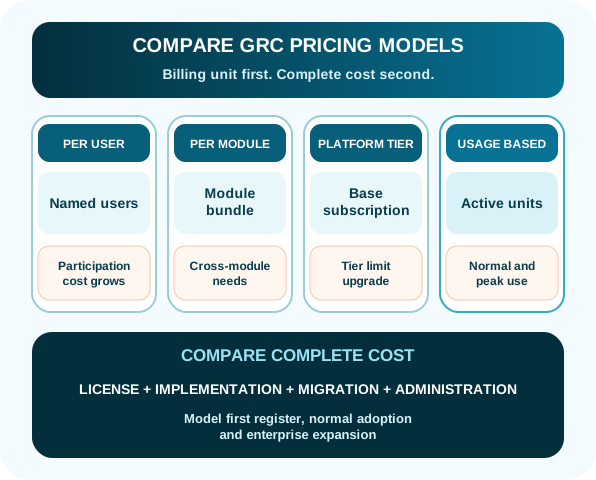
GRC and IRM software prices are difficult to compare because vendors use different licensing units and packaging. A low starting quote can change when more users, modules, entities or environments are added.
Build a cost model around how the organization will actually use the platform over several years, not only the first implementation phase.
Per-user pricing
Per-user models charge for named, active or concurrent users. They can be predictable when a small specialist team does all work.
The tradeoff appears when hundreds or thousands of business owners need occasional access. Organizations may limit participation or share exports to avoid adding licenses, which weakens the quality of source data.
Per-module pricing
Module pricing groups capabilities into packages such as risk, compliance, audit, third-party risk or continuity. It can align cost with initial scope.
Ask what happens when a workflow crosses modules. A risk program may need controls, issues, tasks and reporting even when the starting use case is one risk register.
Platform and tier pricing
A platform subscription may include a base capability, infrastructure or a defined usage allowance. Higher tiers can add features, support, environments or scale.
Confirm what is included in the base price and which limits trigger a tier change.
Usage-based pricing
Usage-based models tie cost to a measurable unit such as active records, assessments or transactions. They can align cost with actual adoption, but the unit must be clearly defined.
Ask how inactive history, templates, test data, reporting and temporary use are treated. Model a normal month, a peak month and expected expansion.
Implementation and operating costs
License price is only one part of total cost. Include configuration, migration, integrations, environments, administration, training, support and future changes.
Ask who can make routine changes and whether specialist consulting is required for common updates.
- Implementation and migration
- Administration and configuration
- Identity and integration
- Training and support
- Additional environments
- Renewal and price-change terms
Parapet pricing
Parapet charges one price per active item, regardless of item type. There is no per-user fee, module fee or minimum item count. Every capability is available from day one.
The flexible price is $5 USD per active item each month with no commitment. The 12-month commitment price is $1 USD per active item each month, billed monthly according to active items in that month.
Inactive and archived items are not charged unless used for reporting or reactivated in that month. Templates and catalogs are free. Taxes are additional where applicable, and customer-hosted deployments use custom pricing. Use the Parapet pricing calculator to model active items.
Build a three-stage cost comparison
Ask every vendor to price the same operating sequence. Record assumptions beside each number so a low first-year quote cannot hide later expansion.
| Stage | Scope to price | Cost questions |
|---|---|---|
| First register | Owners, permissions, migration and the first reporting audience | Which users, modules, services and environments are required to launch? |
| Normal adoption | Controls, issues, remediation and additional business participants | Which thresholds change recurring cost? |
| Enterprise use | Additional domains, history, integrations, support and change | What is the expected three-year operating cost and which assumptions drive it? |
The US GAO cost guide is written for program estimates rather than GRC products, but its discipline is useful here: define scope and assumptions, account for lifecycle cost and uncertainty, and update the estimate when actual use changes.