
Risk registers
How to Consolidate Risk Registers Across Business Units
A step-by-step method for creating one enterprise risk picture from separate business and technology registers.
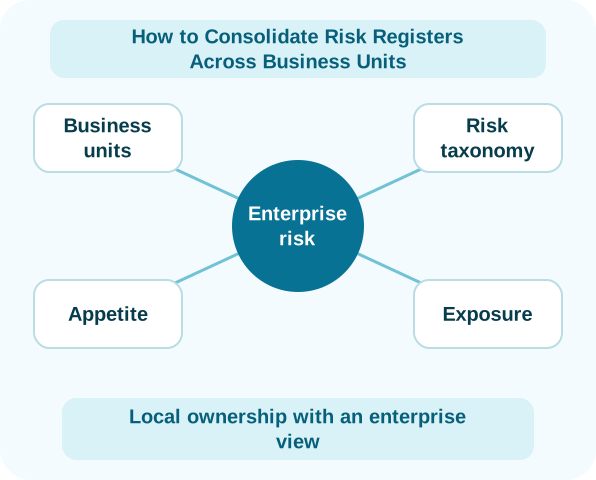
Separate risk registers can work well for individual teams. The problem appears when leadership needs one answer about exposure, ownership and action across the organization.
Successful consolidation is not a spreadsheet merge. It is an operating-model exercise that defines the minimum common structure, preserves local context and assigns responsibility for keeping information current.
1. Define the decision the consolidated view must support
Start with the questions the enterprise view must answer. Examples include where exposure exceeds appetite, which risks affect critical objectives, where controls are weak, and which treatments are overdue.
Avoid collecting fields merely because they exist in a source register. Every required field should support ownership, assessment, comparison, escalation or action.
- Who will use the consolidated view?
- Which decisions must it support?
- How current must the information be?
- What detail must remain restricted?
2. Inventory each current register
Create a simple map of every register, its owner, audience, review cycle, scoring model, categories and supporting action logs. Record where the same risk, control or issue appears more than once.
The inventory reveals whether the main problem is inconsistent structure, duplicate content, unclear ownership or the absence of a reliable consolidation process.
3. Agree the minimum common taxonomy
Choose the categories and measures required for comparison across business units. Keep the common layer small enough to use consistently.
Teams may retain additional local fields, but enterprise reporting needs shared definitions for material concepts such as category, owner, likelihood, impact, rating, appetite status and review date.
- Publish definitions with examples
- Separate inherent and residual assessment
- Define how appetite status is determined
- Name the accountable owner for each field
4. Map rather than overwrite
Map each source value to the agreed structure. Do not silently convert ambiguous categories or scores. Flag uncertain mappings for an owner to resolve.
Retain the original source identifier so the migration can be reconciled. Decide which historical versions are useful, which records are inactive, and which duplicates should be linked or retired.
5. Clean ownership and review dates
A consolidated register is unreliable if risks have generic owners, departed employees or overdue reviews. Confirm accountable owners and set a review expectation before migration.
Where ownership is unresolved, make that a visible exception rather than filling the field with a convenient placeholder.
6. Pilot with one meaningful register
Choose a register that matters enough to demonstrate value but is contained enough to manage. Enterprise or IT risk is often a practical starting point.
Validate representative journeys: creating a risk, updating an assessment, linking controls, assigning treatment, restricting access and producing a leadership view.
7. Govern the combined model
Consolidation is complete only when there is a repeatable process for taxonomy changes, ownership, review, quality checks and reporting.
Define who can change common values, how teams request changes, and how exceptions are resolved. A platform can automate parts of the workflow, but governance still determines whether the data remains useful.
A practical next step
Use the free Parapet risk register template to define a baseline, or review how Parapet risk register software connects team registers to one enterprise view.
For qualifying Parapet SaaS implementations, migration of existing risk registers can be complimentary after scope and data quality are reviewed.
Use disagreement as a design test
Choose two real risks that different teams classify or score differently. Ask both owners to explain their reasoning, then decide which information must be common for enterprise oversight and which context should remain local. A taxonomy that works only for easy examples is not ready for migration.