
Integrated risk management
Replacing Spreadsheets and Disconnected Risk Tools
Identify when spreadsheets have reached their limit and migrate risk processes without recreating every legacy problem.
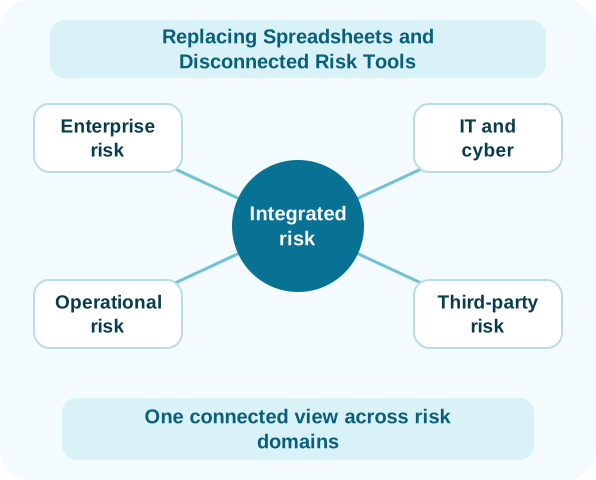
Spreadsheets are flexible, familiar and useful for designing a new register. Problems arise when several teams need concurrent updates, controlled access, linked records and consolidated reporting.
The move to a platform should improve the operating model rather than reproduce every worksheet, field and workaround.
A representative migration decision
Imagine three registers with 74 columns between them. Some columns describe the same concept under different names, others feed a report no longer used, and several contain formulas that only one person understands.
The right migration does not create 74 platform fields. It identifies the common owner, assessment, appetite, review and reporting information; preserves domain detail that still supports work; retains useful source references; and parks inactive history according to an agreed rule.
| Keep | Combine or map | Retire or archive |
|---|---|---|
| Current risk statement, owner, assessment, decision and active treatment | Equivalent categories, ratings, status values and date fields | Duplicate helper columns and fields with no current user |
| Required evidence and source identifier | Different labels for the same business concept | Broken formulas and presentation-only formatting |
| History needed for reporting or accountability | Local categories mapped to a common enterprise layer | Inactive records with no required operational role |
Recognize when spreadsheet risk management has reached its limit
Common warning signs include competing versions, manual consolidation, inconsistent scales, broken links, generic ownership, delayed reviews, separate action logs and sensitive information shared too broadly.
Measure the effort spent collecting, reconciling and explaining information. That often reveals more value than counting spreadsheets.
Choose the first process
Start with a register that has a clear owner, meaningful reporting need and manageable scope. Enterprise risk or IT risk is often suitable because the consolidation problem is visible.
Define what success means for owners, the risk team and leadership.
Simplify before migration
Inventory fields and remove those that do not support a decision, obligation or workflow. Identify duplicates, inactive records, invalid owners and unclear scores.
Retain useful history, but do not let poor historical structure dictate the new model.
Design the common layer
Agree the minimum taxonomy, assessment values, ownership, status and review rules required across teams.
Preserve additional local context where it supports work, but avoid creating a unique data model for every register.
Migrate with reconciliation
Keep source identifiers, document mappings and validate totals and representative records. Resolve ambiguous transformations with record owners.
Test permissions before exposing sensitive registers to new user groups.
Move action into the same working view
Connect controls, issues, decisions and remediation to the risk records that created them. Avoid recreating a separate spreadsheet for action tracking.
Use notifications and reporting to support accountability, but keep expectations clear outside the tool as well.
Expand after the first register works
Add adjacent teams using the proven structure and governance. Review which shared controls, catalogs and dashboards can be reused.
Qualifying Parapet SaaS implementations include complimentary migration. Explore implementation and migration and connected risk registers.
Do not migrate the workaround
Mark every source column as required for a decision, required for reporting, required for migration evidence or no longer needed. Challenge formulas, hidden sheets and color conventions that compensate for missing workflow or ownership. The target platform should preserve useful meaning, not every historical inconvenience.