
Operational risk
Operational Risk Management Software Buyer's Guide
A practical buyer's guide for connecting operational risk, events, controls, issues and treatment across teams.
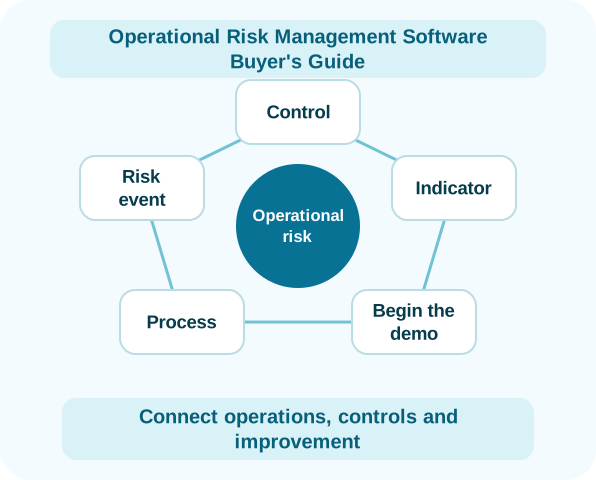
Operational risk management software should help an organization understand how failures in people, processes, systems and external dependencies affect objectives and services.
The platform needs to support everyday ownership and enterprise oversight. If it becomes only a central reporting database, the information will age quickly.
Begin the demo with one operational event
Give each vendor a short scenario: a manual handoff fails, customers are affected, the control did not operate as expected, and a corrective action crosses two teams. Ask them to show what the event changes.
The demonstration should connect the event to the process or service, relevant risk and control, resulting issue, action owner, evidence and management report. If the story breaks into separate modules or exports, note the administration required to join it again.
Define the operating model first
Clarify who identifies risk, who owns it, how assessment works, how events are captured, how controls are evaluated and how issues are escalated.
Software should support that model without requiring every business area to become a specialist risk team.
Connect process and service context
Operational risk is meaningful when related to the process, product, service, location or objective it can affect.
Test whether the platform can show shared dependencies and aggregate exposure without duplicating the same risk across several registers.
Link events, controls and issues
A risk register describes uncertainty. Events show what happened. Controls influence likelihood or impact. Issues identify gaps. Remediation changes the future state.
Evaluate whether these records connect naturally and whether owners can move between them without losing context.
Support scenario and assessment discipline
Assessment scales should be consistent enough for comparison but clear enough for business owners to use. Review how qualitative context is retained alongside ratings.
If scenario analysis is important, define the inputs, assumptions and outputs required rather than accepting a generic feature label.
Make reporting actionable
Operational risk dashboards should identify concentration, significant movement, control weakness, event patterns, appetite exceptions and overdue treatment.
Require traceability from a summary to the underlying records and owners.
Review access and participation
Operational risk information can be sensitive and widely distributed. Test item-level security, role-based permissions and group access with real examples.
Understand whether business participation creates additional user-license costs.
Questions worth asking twice
A polished first answer can hide important operating dependencies. Ask the product administrator and business user versions of the same question.
- Who changes the taxonomy after launch?
- What happens commercially when event management needs controls and remediation?
- Can one control be reused without copying its assessment?
- Can sensitive events be restricted while aggregated exposure is reported?
- How does an owner see overdue work without another spreadsheet?
Compare total cost and adoption
Include implementation, migration, administration, training, integrations and expansion in the cost model.
Parapet includes every capability from day one, uses per-active-item pricing and does not charge per user. Explore Parapet operational risk management for the connected approach.
Demonstrate the event twice
First show the event as an operational owner would record it. Then show the same event from the risk leader's view, including the affected process, control weakness, change in exposure and corrective action. If the second view requires copying the event into another module, ask how consistency will be maintained.