
Integrated risk management
GRC vs ERM vs IRM: What Is the Difference?
A plain-language comparison of GRC, ERM and IRM, with practical questions for software evaluation.
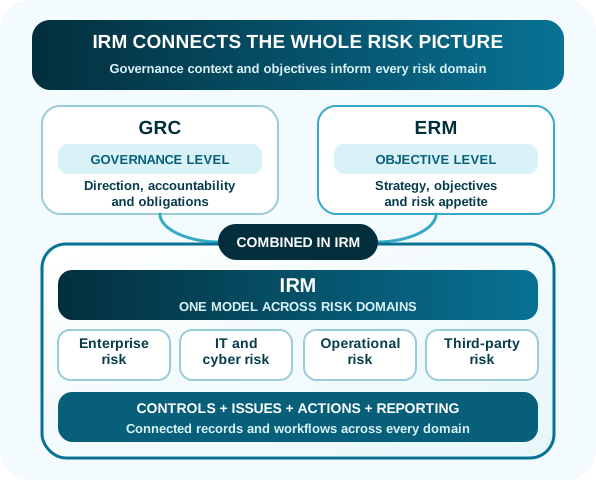
GRC, ERM and IRM are often presented as three competing software categories. That framing misses the useful relationship among them.
For this guide, GRC supplies governance and compliance context, ERM connects risk to enterprise objectives, and IRM brings both into the risk domains where people assess exposure and act. IRM is the connected operating layer, not a third isolated column.
The short version
Think of the concepts as different views of the same organization rather than three separate boxes.
| View | Question it helps answer | Typical context |
|---|---|---|
| GRC | Who has authority, what obligations apply, and how is accountability evidenced? | Governance, policy, compliance, controls and assurance |
| ERM | Which uncertainties could affect our objectives and risk appetite? | Strategy, objectives, appetite and the enterprise portfolio |
| IRM | How do teams manage those risks across domains with related information and action? | Enterprise, IT, cyber, operational, third-party, compliance and resilience work |
A practical example
Suppose a critical supplier supports an online customer service. The board-approved policy and contractual obligation are part of the GRC context. The service objective, appetite position and enterprise exposure are part of the ERM context.
The supplier assessment, technology dependency, recovery control, issue and remediation are where IRM does the connecting work. Keeping those records related is what lets governance and objectives influence the daily risk decision.
Why software labels still cause confusion
A product described as GRC may be a narrow compliance tool or a broad enterprise platform. A product described as ERM may focus mainly on registers and reporting. The label alone does not show how well the product connects records, owners and action.
Ask the vendor to use one of your own risk scenarios and show the complete journey. That is more revealing than asking whether the product supports an acronym.
Software evaluation questions
A connected demonstration should show how the views meet in day-to-day work.
- Can objectives, services and obligations give a risk its context?
- Can risks connect to controls, assessments, issues and actions?
- Can different teams retain suitable access and working views?
- Does expansion require more modules or user licenses?
- Can leadership reporting reach the current source records?
Where Parapet fits
Parapet is an integrated risk management platform. It supports enterprise, IT, cyber, operational, compliance, audit, third-party and resilience activities through one connected model.
Every capability is available from day one. Pricing follows active items rather than users or modules, which supports broad participation without creating a license decision for each owner.
Use one record to test all three views
Take a material supplier dependency and ask three groups to examine the same underlying situation. The governance or compliance view should identify authority, policy and obligations. The enterprise view should show the objective, appetite position and portfolio consequence. The integrated risk view should show the service dependency, assessment, control, issue and action used to manage it.
If the demonstration creates three unrelated records, the product label is doing more work than the operating model.